
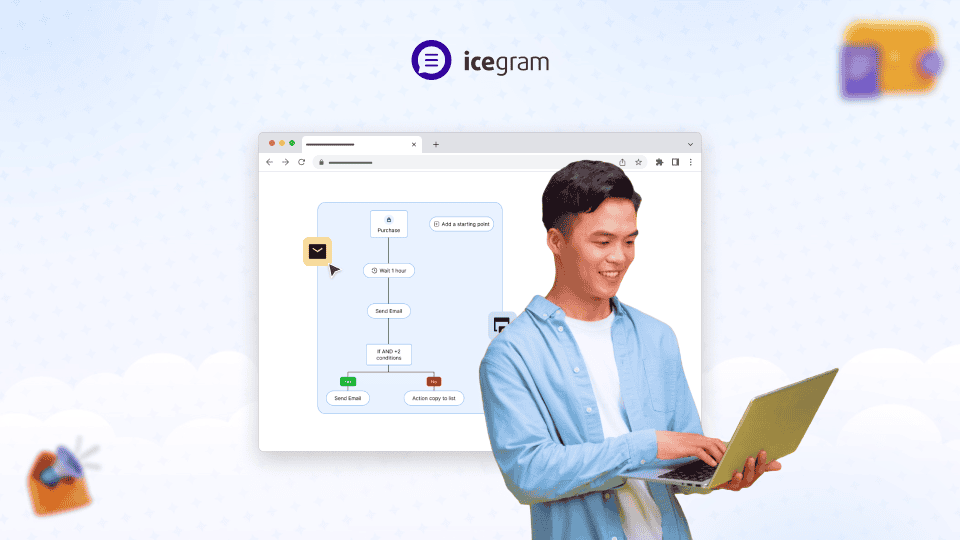
Why do timed, automated emails outperform random one-off blasts?
Because they are based on context, rather than assumptions.
If someone just signed up, downloaded a resource, or viewed a product page, a follow-up email is an essential step to nudge your prospects to conversion!
Email drip campaigns create that continuity. They keep the conversation moving, increase engagement, reduce drop-offs, and improve conversions.
And the best part is that it can be done without manual intervention with an email drip campaign software.
With the right software, everything runs on logic, not guesswork.
In modern email marketing, drip software isn’t a bonus feature, but a core infrastructure.
Best email drip campaign software: Choose wisely!
Icegram Express
Best for: WordPress-native email automation
Icegram Express (formerly Email Subscribers & Newsletters) is designed specifically for WordPress environments.
Key capabilities:
- Automated welcome and post notification emails
- Drip campaign functionality
- Subscriber segmentation
- WordPress integration
- List hygiene tools
For businesses running on WordPress, a native solution reduces integration friction and keeps automation aligned within the same ecosystem.
ActiveCampaign
Best for: Advanced automation and behavioral workflows
ActiveCampaign is built around automation depth. Its visual workflow builder supports complex branching logic, tagging, goal tracking, and event-based triggers.
Key capabilities:
- Visual automation builder with conditional logic
- Advanced segmentation and tagging
- CRM integration
- Site and event tracking
- Detailed performance reporting
If your strategy requires precise behavioral triggers and multi-path sequences, this platform offers strong workflow control.
Mailchimp
Best for: Ease of use with structured automation
Mailchimp provides pre-built customer journey templates and rule-based automation workflows. It supports segmentation, behavioral triggers, and eCommerce integrations.
Key capabilities:
- Customer journey builder
- Pre-built automation templates
- Segmentation and tags
- A/B testing
- Analytics dashboard
It balances usability with automation flexibility, making it suitable for growing email programs.
Brevo (formerly Sendinblue)
Best for: Cost-effective automation with multi-channel support
Brevo offers visual workflow automation, email scheduling, transactional email capabilities, and SMS integration.
Key capabilities:
- Drag-and-drop automation builder
- Behavioral triggers
- Contact segmentation
- Email + SMS workflows
- Real-time reporting
It’s often chosen by teams that want automation plus transactional messaging in one system.
Kit
Best for: Creator-focused automation
Kit emphasizes tagging and event-based automation rather than traditional list-based structures.
Key capabilities:
- Visual automation builder
- Tag-based subscriber management
- Conditional content
- Landing pages and forms
- Commerce features for creators
It works well for content-driven businesses that rely on structured nurture sequences.
GetResponse
Best for: Automation + funnel building
GetResponse includes a workflow automation builder along with webinar hosting and funnel tools.
Key capabilities:
- Automation workflows with conditions and filters
- Time-based and behavior-based triggers
- Conversion funnel builder
- Advanced segmentation
- Performance analytics
It supports drip campaigns tied directly to funnel stages.
HubSpot
Best for: CRM-driven automation
HubSpot’s Marketing Hub integrates drip campaigns directly into its CRM, enabling lifecycle-based automation.
Key capabilities:
- Workflow automation builder
- Lifecycle stage triggers
- Deep CRM integration
- Lead scoring
- Advanced reporting dashboards
For teams needing email automation tightly aligned with sales processes, this platform provides unified data control.
Klaviyo
Best for: eCommerce behavioral automation
Klaviyo specializes in event-driven automation for online stores.
Key capabilities:
- Pre-built eCommerce flows (abandoned cart, post-purchase, browse abandonment)
- Deep Shopify and WooCommerce integrations
- Predictive analytics
- Dynamic segmentation
- Revenue attribution reporting
It is particularly strong in timing-based and revenue-focused drip campaigns.
Drip
Best for: Data-driven eCommerce lifecycle automation
Drip focuses on behavior-driven workflows and revenue tracking for online businesses.
Key capabilities:
- Visual workflow builder
- Tagging and segmentation
- Behavioral triggers
- Revenue attribution tracking
- eCommerce integrations
It emphasizes performance visibility across customer journeys.
Moosend
Best for: Affordable automation with core features
Moosend offers automation workflows, segmentation, and real-time analytics at competitive pricing tiers.
Key capabilities:
- Automation workflows
- Time and event-based triggers
- Segmentation tools
- Landing page builder
- Reporting dashboards
Suitable for businesses seeking structured drip campaigns without enterprise-level complexity.
How does email drip campaign software help businesses?
Email drip campaign software is built for one thing: structured, automated communication.
Instead of sending emails manually, you create a sequence, and the system delivers each message based on a schedule or a behavioral trigger.
The core purpose of drip software is to ensure every email goes out at the right time. This could be after signup, after engagement, or even after inactivity. Each message follows a logical order, keeping communication relevant and consistent without manual effort.
Moreover, as your business grows, manual email sending becomes unsustainable.
More subscribers. More follow-ups. Communication has to move fast and go in the right direction.
Drip campaign software solves this by automating onboarding sequences, follow-ups, and nurture flows.
But automation alone isn’t the advantage.
Timing and relevance are also vital aspects to drive performance. Drip campaigns ensure the right message reaches the subscriber at the right moment. Considering context improves engagement and conversions.
Moreover, a drip software also focuses on maintaining a unified messaging flow, which paves the way for consistency. It standardizes communication, reduces gaps, avoids repetitive emails, and creates a cohesive experience across the entire customer journey.
Key features to look for in email drip campaign software
If drip campaigns are a core part of your communication strategy, your software can’t be basic.
So what should you actually look for?
Visual or rule-based automation builders
Can you clearly see how your workflow runs?
An effective platform should offer intuitive visual maps or rule-based builders. You should be able to design sequences, define triggers, and understand progression paths without confusion.
Email scheduling and delay controls
Is your timing precise, or do your emails simply go out at random times?
Look for time-based delays, event-triggered emails, and timezone-aware delivery. The right message only works if it arrives at the right moment.
Subscriber segmentation and tagging
Are you segmenting your subscribers the right way?
Strong segmentation and tagging help you tailor drip sequences based on behavior, interests, or lifecycle stage. Making your communications relevant prevents your emails from becoming generic.
Email templates and personalization
Can you move fast without losing customization?
Pre-designed templates maintain consistency, while dynamic fields and conditional content personalize emails at scale.
Performance tracking and analytics
Do you know what’s actually working?
Detailed analytics such as open rates, click-throughs, workflow progression, and conversions provide insights that are required for continuous, data-driven improvement.
If drip campaigns are mandatory in your toolbox, these features shouldn’t be optional.
How to set up effective drip campaigns?
Setting up effective drip campaigns isn’t always straightforward.
But with the right structure, it becomes manageable and sustainable too.
Here’s how to approach it:
Defining goals and triggers
What’s the purpose of your campaign?
Is it onboarding, nurturing, or re-engagement?
Start with one clear objective. Further, you can connect it to specific triggers such as signups, content interactions, and inactivity. The trigger determines when a subscriber enters the workflow. Clarity is of prime importance here, as without clarity, the sequence loses its direction.
Structuring email sequences logically
Does each email naturally flow to the next?
Your sequence should match your audience’s respective customer journey. Educational or informational emails usually come first. Promotional or action-driven emails follow once you have established the context.
Balancing frequency and timing
Building momentum without the right frequency can lead to fatigue.
Too many emails could overwhelm subscribers. Likewise, long gaps could reduce engagement. The right drip software lets you control spacing and delivery timing so communication is not only consistent but also measured.
Testing and optimizing sequences
Running the same sequences without improving?
You might be defeating the purpose of email drip campaigns.
Test subject lines, content formats, and timing delays regularly. Use engagement data to refine each step, every time you send out an email. Continuous optimization can lead to a high-performing sequence.
Conclusion
If you want to run email programs at scale, structure is essential.
With drip emails, every email connects to user behavior and intent across the lifecycle, with absolutely no guesswork.
And drip software shouldn’t be treated as a short-term tactic.
This is why platforms that integrate it smoothly with existing marketing workflows and WordPress environments stand out. When automation, segmentation, and delivery work together inside one cohesive ecosystem, email marketing becomes sustainable and performance-driven.
Structure leads to consistency, and consistency drives results – an amazing domino effect.
Looking for a powerful tool for your drip email campaigns to change the game? Why not check out Icegram Express?
FAQ
Can drip campaigns be used for transactional or post-purchase emails?
Yes. Drip campaigns are often used after a transaction to deliver order-related updates, usage tips, upsell guidance, or renewal reminders, helping extend engagement beyond the initial conversion.
How long should a typical drip campaign run?
The duration depends on the campaign goal. Short onboarding drips may run for a few days, while lead-nurture or education-focused campaigns can extend over several weeks without requiring constant adjustments.
Do drip campaigns affect email deliverability?
When configured correctly, drip campaigns can improve deliverability by maintaining predictable sending patterns and steady engagement. Poor configuration or aggressive volume spikes, however, may negatively impact inbox placement.
Are drip campaigns suitable for B2B and B2C businesses alike?
Drip campaigns are effective in both contexts. B2B programs typically focus on education and longer decision cycles, while B2C campaigns often emphasize onboarding, product usage, and repeat engagement.