 |
||
|
“Marketing history isn’t just fun trivia. It’s where today’s best ideas were born.” – Nirav Mehta |
||
|
Hi there, Last week I fell into one of those internet rabbit holes that starts with “I’ll read one article” and somehow ends with a dozen tabs open at 1 a.m. That’s when I stumbled upon something I couldn’t stop thinking about. The first successful marketing email in history almost got its sender fired. One email. One warning. $13 millionOn May 3, 1978, a DEC marketing manager named Gary Thuerk did something nobody had ever done before. He sent one email to 393 people at once. No segmentation. No A/B testing. No unsubscribe link. No automation. Just one email inviting people to see DEC’s new computers, sent across ARPANET the network that would eventually become the internet. His bosses weren’t exactly celebrating. Neither was the U.S. Department of Defense. They reportedly told him, in no uncertain terms, not to do it again. And yet… That one email is believed to have generated around $13 million in sales. Today, it’s remembered as the world’s first spam email. It’s also the first email marketing campaign that actually worked. Funny how history works sometimes. 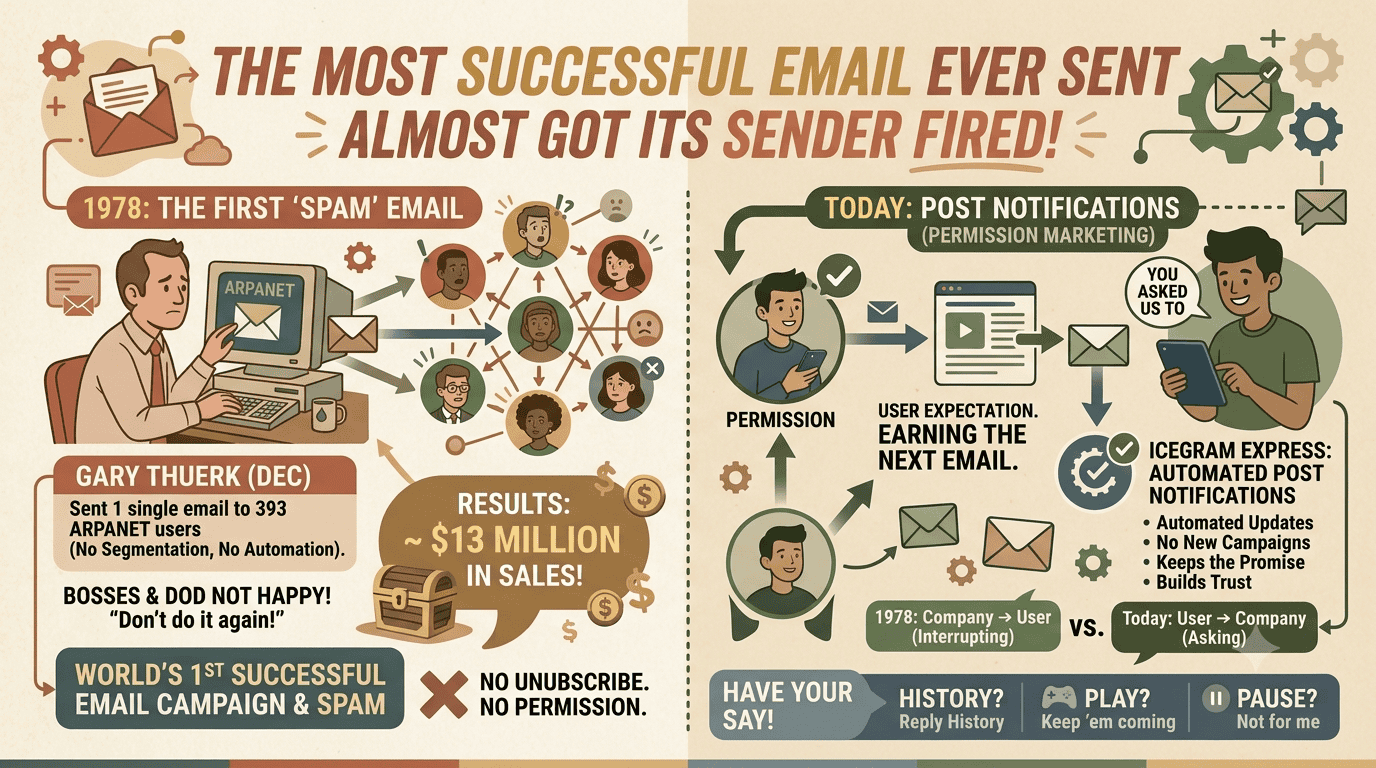 So… why did it work?Because back then, nobody had ever seen anything like it. For the first time, a company could reach hundreds of people with a single click. It was new. Unexpected. Impossible to ignore. But success has a funny way of changing the rules. What worked because it was different quickly became something everyone copied. And when everyone started sending emails… People stopped paying attention. If Gary sent that exact same email today… It probably wouldn’t work. In fact, it’d probably land straight in Spam. Why? Because people don’t reward interruption anymore. They reward relevance. Think about your own inbox. Most emails are gone in two seconds. But there are a few you actually look forward to. The difference isn’t just a better copy. It’s that those senders earned the right to be there. That’s the shift email marketing has been chasing ever since. 📌 Innovation begins where ‘this is how it’s always been done’ ends. Then the internet flipped the scriptA few years later… RSS feeds became popular. Instead of marketers deciding when to interrupt people… People started saying, “I’d like to know when there’s something new.” That’s a tiny shift in wording. But a massive shift in psychology. The conversation changed from “We’re telling you.” to “You asked us to.“ And honestly… That’s still one of the biggest differences between spam and genuinely helpful email. A promise worth keepingOne thing hasn’t changed since 1978. People still don’t want more emails. They just don’t want to miss something they actually care about. Maybe it’s your latest blog. Which brings me to think of… Post Notifications in Icegram Express. The moment you publish something new, your subscribers automatically hear about it. No extra campaign. No reminders. No manual work. Just delivering on a simple promise: “I’ll let you know when there’s something worth reading.” Try this little experiment…Before your next blog goes live… Turn on Post Notifications. That’s it. Publish exactly as you normally would. Let Express handle the rest. Sometimes the best automations are the ones you forget are even running. Should I keep digging?While researching this story, I realised almost every feature we use today has a fascinating origin story.
And honestly? Those stories are far more interesting than another feature announcement. So I’m thinking of turning this into a short series. Not tutorials. Not sales emails. Just the unexpected history, psychology, and lessons behind the tools marketers use every day and what we can learn from the people who came before us. BTW, Do you love learning how today’s marketing ideas actually began? Should I continue this series? Reply ‘PLAY’ for yes and ‘PAUSE’ if you feel, “It’s not for me.” I’ll genuinely use your replies to decide whether I write the next four. And if you have a favourite piece of marketing history, I’d love to hear that too. Until next time, |
||
|
