 |
||
|
“I’m sorry. Our intentions were good.” – Ethan Zuckerman |
||
|
Hi there, The last email got some of the best replies I’ve had in a while, and I can’t tell you how happy that made me. So, as promised, here’s Episode 2 of “Where It Started.” While looking for the next story, I came across this one. Something we regulary see and use. 1997. Tripod.com.Tripod was one of the early places where anyone could build a free homepage. The business model was simple: let people publish for free, and make money from advertising. But there was a problem. [More] Advertisers didn’t always want their banners sitting next to whatever users had put on their pages. So a programmer named Ethan Zuckerman was asked to find a solution: keep the ad money coming, but keep the brand away from the content. His fix was small. A little odd. And, for the problem in front of him, genuinely clever. Open another window. Put the ad there. Technically, it wasn’t “on” the user’s page anymore. That’s it. That’s the pop-up ad. 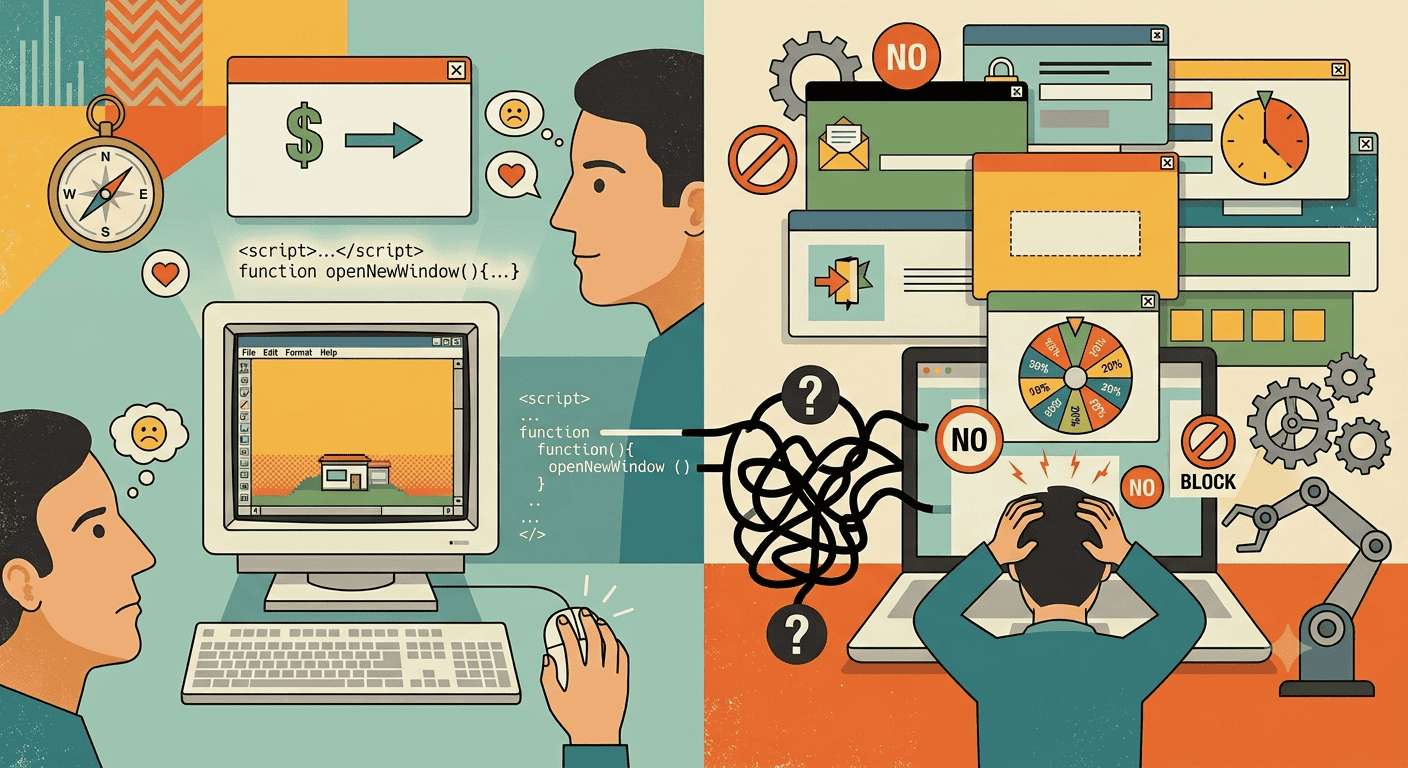 It worked. Then it got out of hand.The idea was copied everywhere. Newsletter signups. Exit surveys. Discount codes. “Before you go!” messages. Soon, the same mechanism was being used for almost everything – on every website, every page, whether it made sense for the visitor or not. The format wasn’t the problem. The context disappeared. By the early 2000s, browsers were shipping built-in pop-up blockers to fight back against how badly the format had been overused. People didn’t hate the idea of a message appearing at the right time. They hated getting the same interruption, at the same volume, regardless of what they were trying to do. Then, in 2014, Zuckerman apologised.In an essay for The Atlantic, he wrote openly about the role he played in creating the pop-up. The line that stayed with me: “I’m sorry. Our intentions were good.” He wasn’t apologising for solving the original problem. He was apologising for what the solution eventually became. And that’s where this little piece of internet history gets interesting for marketers today. Because we do this all the time. Something works. So we scale it. Then we automate it. Then, somewhere along the way, we stop asking why it worked in the first place. A pop-up isn’t necessarily the problem.
The same popup appearing the second someone lands on your homepage, before they’ve even had a chance to look around? Probably not. The difference is intent. And that’s the bit I think is easy to forget in marketing: Don’t just ask what you want to show. Ask why this person should see it right now. That’s also the thinking behind Icegram Engage. Instead of “show this popup to everyone,” you can trigger messages based on what someone is actually doing – about to leave, scrolling through an article, spending time on a pricing page, visiting a specific page, and more. The popup is just the mechanism. The real strategy is the moment you choose to use it. And in a world where people are already drowning in messages, that matters more than ever. Better marketing isn’t always about reaching more people. Sometimes, it’s about knowing when not to interrupt them. And…There’s a funny connection to our next episode. Next time, I want to tell you about a feature that exists because of a typo. Which got me thinking: Have you ever built or tried something with one intention, only to get a completely unexpected result? Reply and tell me. You know how much I love hearing from you. And one quick question while you’re here: Do you use pop-ups on your site? Reply “POP-UP” if you do, or if you’ve ever done so before. And tell me which plugin you use. Is it Engage? Something else? I invite you to share more such stories if you have any. I would love to feature yours in the next email. 📌 P.S. Also, if you’d like help setting up a pop-up on your site or want to explore what else you can do with Engage, reply with “CALL” and I’ll schedule a call for you. Until next time, |
||
|
